Scale Reference
E Blues Scale | Triads
The E blues scale with its triads highlighted across the fretboard. Understanding where the chord tones sit within the blues scale is what separates players who solo over changes from players who just run the scale.
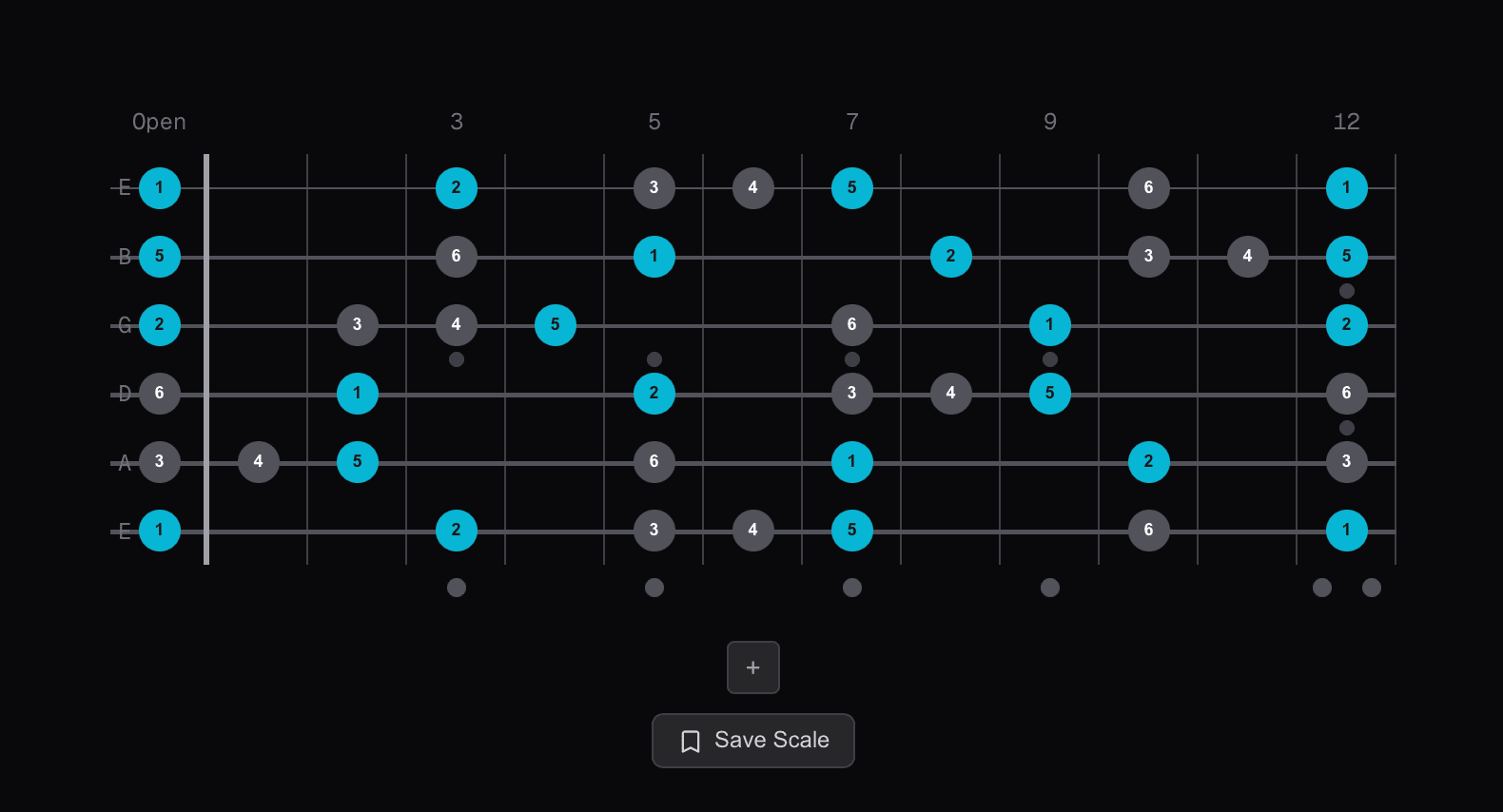
Triads in the E blues scale
The E blues scale shares its triads with the E minor pentatonic | an E minor triad (E, G, B) and a G major triad (G, B, D). The added blue note (Bb) is a passing tone, not a chord tone, so the triads remain the same.
In a 12-bar blues in E, you'll typically solo over E7, A7, and B7 chords. The blue note (Bb) creates tension over all three | it resolves into B natural, which is the 5th of E, the root of B, and sits right in the middle of the A7 chord.
How to use this
Use the blue note as a passing tone to approach chord tones from below. Sliding or bending from Bb up to B natural over an E chord is one of the most expressive moves in all of blues guitar.
Explore triads interactively
Build progressions, toggle individual chords on and off, and experiment with every triad across the full neck.
Open in Scale Mapper →